I own and invest in businesses. The problem owners bring me most often is not that they can’t find good people. They can. They hire them, and somewhere around month six the good ones leave, and the owner concludes that the talent market is to blame.
In my experience, good people rarely leave over money. They leave because there is nothing for them to own. If every decision still routes through you, you haven’t created a job for a capable person, you’ve created a queue. Building high performing teams starts with fixing that, not with recruitment.
What is a high performing team?
A high performing team consistently delivers more than the people in it would on their own. That happens because they share a clear goal, hold each other accountable to a standard, and can make decisions without asking permission. They are not always the most talented or experienced people available, and that isn’t what makes them work.
The distinction I use is simple. A good team does what you ask, and does it well. A high performing team does what’s needed when nobody has asked. You need the second kind if you want a business that works without you, because you can’t scale while you are still the person doing the work that keeps the business running.
A test I often put to owners is to turn the phone off for three weeks. When you come back, is there a functioning business waiting for you, or a pile of decisions and reasons why things couldn’t happen while you were away? If the business paused, that pause is the diagnosis. Whatever waited for you is the constraint to work on next.
It’s also worth asking why you went into business in the first place. Most owners didn’t take on the risk and the payroll so they could be the last person to get paid. The reward isn’t only money. It’s time, and the chance to build something that lasts. You need to be paid first, not last.
Busy doesn’t mean high performing, either. Walk into most offices, or open most team chats, and everyone looks busy. What matters is whether they’re moving the needle, and the only reliable way I know to tell is a weekly dashboard. Like the dashboard in a car, it shows whether there’s enough fuel, whether you’re at the right speed and whether you’re still following the route. When it shows you’re off course, that’s when you step in. With a good dashboard in place, you can check in from anywhere in the world.
What are the characteristics of high performing teams?
The high performing teams I’ve built and worked with all have five things in place: clarity on the numbers, control of each result, consequences when targets are missed, an owner who develops people, and a clear line from each person’s work to the outcome. I remember them as the five C’s. The name is my own memory aid.
Clarity comes first. Numbers are the language of business, and almost everything can be measured, including how people feel, as long as you score it consistently. If a goal is subjective, nobody can tell whether they’re winning.
Control means someone other than you owns each part of the P&L. The P&L shows where the money comes in, where it goes out and how the business makes a profit, so it is the most honest map of who should be responsible for what. If your name sits against most of it, that’s the first thing to change.
Consequence is where many owners go soft. In the businesses I work with, we run the dashboard on red, amber and green. Say marketing needs 50 new leads a week:
- Green is 50, and keeps you on track for the year.
- Amber is anything over 30.
- Red is anything below that. Week after week, it means the business is heading under break-even.
I always start with marketing because it’s the top of the funnel. If that’s red, nothing further down can make up for it.
The consequence of red doesn’t have to be punishment. It can simply be that nobody grows, and capable people won’t stay in a business that isn’t winning. You, as the owner, have the resilience to ride it out. They can decide it’s not the right vehicle for them and move on.
Coaching is the owner’s part. When someone joins one of my businesses, I ask about their goals, because I need to know what to budget for, what to invest in them and how much of my time they’ll need. Bringing out the best in people goes beyond teaching them. It means supporting them, and keeping them going when they win silver instead of gold.
Contribution is the line of sight from Tuesday’s work to something that moved. Isolate people from the results and they drift within months. It also means thinking about the mix. A team made up entirely of star players is like fielding eleven Ronaldos: plenty of talent and a great deal of drama. What works better is one or two people who set the pace, and a strong supporting team who keep the rhythm going on the difficult days.
How do you build a high performing team?
I build a high performing team by putting the conditions in place first and hiring second. That means a weekly dashboard, one owner for each result and an agreed response when numbers turn red. Only then do I recruit, and I look for people with goals of their own, because their goals become part of the business’s goals.
When owners ask me how to create a high performing team, my first point is always the order. Hire a capable person into a business with no clarity and no control, and you have given them the reason they will leave.
When I’m recruiting, the question I rely on is a simple one: what are your goals? I asked it in a second-stage interview recently, and the candidate told me they had never really thought about it. They were there to get a job. That doesn’t make someone a bad hire, because every business needs steady people who don’t want the bigger goals. It did tell me they weren’t going to be the person who pushes the business forward.
Whatever you agree, agree it in conversation rather than by email. Then write it down and have both of you sign it. It’s not a legal step, just a way to make sure nobody is unclear later.
Titles matter more than owners think. If you call yourself managing director or CEO and still do everything, the business is organised around your importance rather than your team’s. The people who should be the heroes are the team.
This also changes what your business is worth. When you come to sell, the price is a multiple of your EBITDA (your profit before interest, tax, depreciation and amortisation), and that multiple depends on whether the business needs you. If it does, expect to be tied in for three, four or five years after the sale while you prove it can run without you. If it already runs without you, you are selling an asset rather than the job you’ve built.
I often compare it to renting out a house. You wouldn’t sit in the corner of the living room fetching biscuits for your tenants and checking the heating. You let them live in it. A business needs the same treatment if the people in it are going to build it for you.
How do you improve team performance?
I improve team performance by changing less, not more. I review the dashboard weekly, act when a number stays red, and leave working systems alone. Every change I’ve made in a business has caused a dip in performance before it paid off, so I make fewer changes and make each one count.
One of the worst pieces of advice I was ever given was that I should be doing something to the business every week. Every change meets resistance. Even a good change causes a drop in performance while people adjust, push back or get used to the new system. Keep changing things and your team never climbs out of that drop.
I think of a business as a garden. At the start it needs your attention, your planning and your guidance. Once it’s growing, it needs watering and checking, not constant pruning. Prune it too often and you’ll kill it. Then you put a gardener in, whether that’s a general manager or a managing director, and you take what you learned to the next garden, where you can do it faster and more profitably.
Once that leader is in place, my role changes. I’m no longer supervising the work. I’m checking whether the leader is keeping to the culture and following the systems I built. McDonald’s is the obvious example of a business that runs on systems. Put a Michelin-star chef in one of its kitchens and they’ll want to do things their own way, because that’s what strong people do.
In my experience, a senior hire will think they know better for roughly their first 15 months, and then they start to learn why things are done the way they are. That’s normal. The balance is to protect the system without taking control away from them. The moment you take control back, the consequence sits with you rather than with them, and the whole thing starts to fall apart. You build the dance floor and let them dance on it.
That, in short, is how I approach building high performing teams: set the conditions, then give good people the room to perform.
If you’d like the same ideas set out as a guide, read how to build a high performing team on Mentor Business.
Listen or watch on your favoUrite platforms
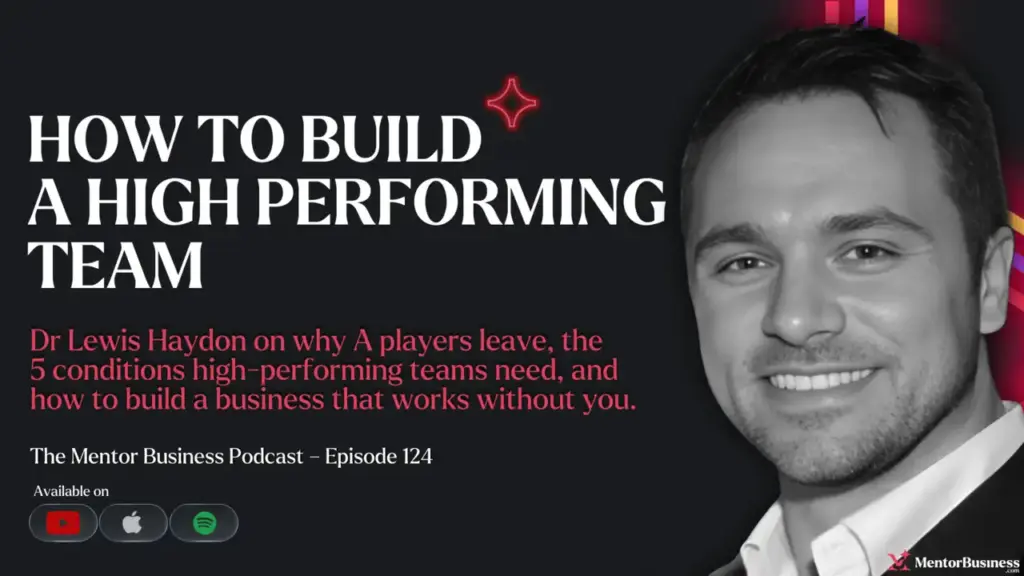
Listen to the full episode: How to Build a High Performing Team — Mentor Business Podcast, Episode 124



I go deeper on team performance and building a business that runs without you in my shows on MentorBusiness.com. Sign up or log in at mentorbusiness.com.
What’s your goal? I’ll tell you the plan.
FAQs
Why do my best employees keep leaving?
In my experience, it's rarely the money. Capable people leave when there's nothing to own, because every decision still goes through the owner.
How do I get my team to work without me?
Put the conditions in place first: a weekly dashboard, one owner for each result, and an agreed response when numbers turn red. Then give people real control.
What should a business owner check every week?
A short dashboard, with each number marked green, amber or red. Act when a number stays red, not after a single bad week.
How long does a new senior hire take to settle in?
In my experience, around 15 months before they stop assuming they know better and understand why your systems work the way they do.
Does a business sell for less if it depends on the owner?
Usually, yes. The multiple is lower, and the owner is often tied in for several years after the sale.