Most small business owners think a CRM is expensive software for big companies. It isn’t. A CRM is a system that remembers your customers so you don’t have to. That matters because people buy from people they know, like and trust, and you can’t build that if you can’t remember the last conversation you had with them.
What is a CRM?
A CRM, short for customer relationship management, is a system that keeps track of every customer and every lead you have, wherever they came from: networking, email, your website or a referral. It holds their details, reminds you when to get back in touch, and stops you looking unprepared when they call.
Think about how it looks when a salesperson can’t remember the last conversation they had with a customer. Now think about that salesperson speaking to 10, 20, maybe 100 people a day. That’s the gap a CRM closes.
There’s evidence behind this too. One of the most cited studies on CRM, in the Journal of Marketing Research, found that the CRM process was linked to better business performance, but the software on its own wasn’t the reason (Reinartz, Krafft & Hoyer, 2004).
That’s the part I find most interesting, because it takes away the excuse. The CRM is a tool; the result comes from the person using it. If your salesperson is blaming the CRM, they need to look in the mirror first. Do they know how it works? Are they taking ownership of the results? If they’re not prepared to do the selling and still blame the tool, the real question is whether they’re in the right seat.
How does a CRM work?
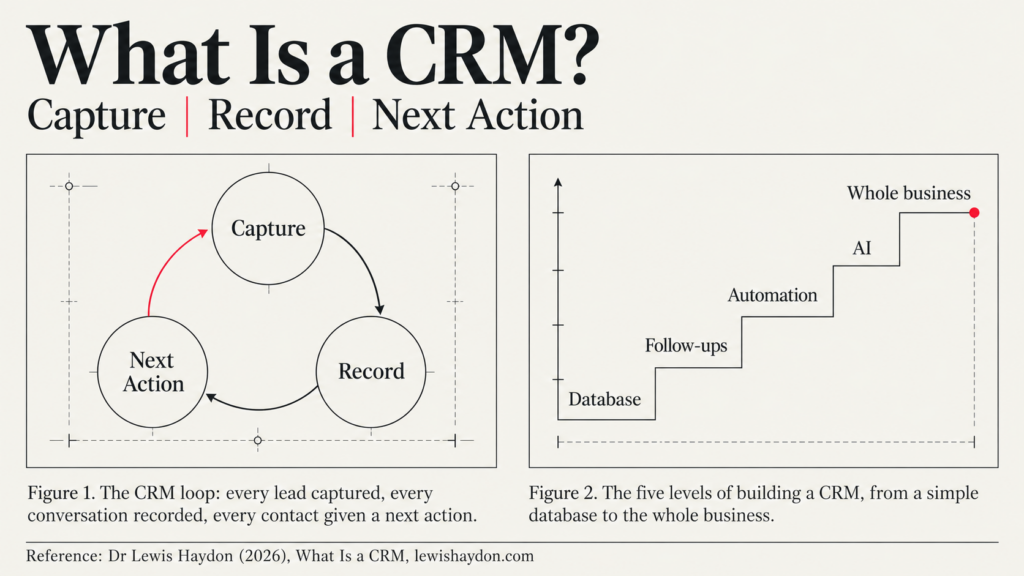
A CRM works in three steps:
- It captures every lead in one place.
- It records every conversation.
- It sets the next action, with a date.
When that date comes round, your team knows exactly who to speak to and why. Most businesses lose sales simply because the follow-up never happens.
When I look at a business that needs more sales, one of the first things I check is whether quotes are going out, and then whether anyone is actually following them up. Most people don’t do follow-up calls. A good CRM makes the follow-up happen at the right moment. If a customer says the job doesn’t start until next month, it knows not to chase them every seven days.
In some of my businesses, AI now reads the conversations from our calls. It reminds the team to call someone back on the date they asked for, and even what they mentioned about their family or their holiday. Nobody has to hold that in their head, and the customer feels genuinely looked after.
How do you build a CRM?
You build a CRM in levels, and you can start today with no budget.
- Level one records names and details.
- Level two adds follow-up dates and your numbers.
- Level three adds automations.
- Level four connects it to AI.
- Level five links it across the whole business.
Don’t let cost be the excuse. Start at level one.
- Level one: build the database. Names, contact details, where they came from. A spreadsheet is fine.
- Level two: dates and numbers. Follow-up dates, a simple dashboard, your conversion rate, and email.
- Level three: automations. When someone replies or moves a step along your sales funnel, the next action triggers on its own.
That last one matters more than most owners realise. If you’re paying a salesperson for eight hours a day, you don’t want two hours of selling and six hours filling in boxes, hunting for phone numbers and writing emails. If a salesperson is there, they need to be selling.
- Level four: connect it to AI. The CRM becomes the brain of the business, and tools like ChatGPT or Claude can read it and do a lot of the heavy lifting.
- Level five: the whole business. Operations, invoicing and accounts all connected and automated.
That’s where it starts to cost more. I’d call it an investment rather than a cost, because when the team uses it properly, everything starts to work together. The aim is a system that shows you where your constraint is, so you know exactly where to focus next. There will always be a constraint. That’s where the growth is.
What’s the best CRM for a small business?
The best CRM for a small business is the one your team actually updates every day. Start with a spreadsheet. Move to software once you need automation: reminders, email follow-ups and a pipeline view. The right choice depends on whether you run a larger team or a smaller service business.
I’m deliberately not naming software here. Good CRMs now connect to your social media, your website, Google and your email, and the right one depends on how your business is set up.
What matters more is what goes into it. Your next customer isn’t a stranger; it’s someone you forgot to call back. A database full of warm leads makes a business worth more. So don’t buy a list. You’d be buying someone else’s old contacts, half of them dead ends. Build your own, with a lead magnet that gives people a reason to join, then nurture them.
You don’t walk into a bar, get down on one knee and propose to a stranger. Selling works the same way, and that’s why the CRM matters.
Your one job this week
Open a spreadsheet, add six columns, and put in every customer and lead you can think of, with a next action date next to each one. That’s 80% of what you need to start getting your sales up.
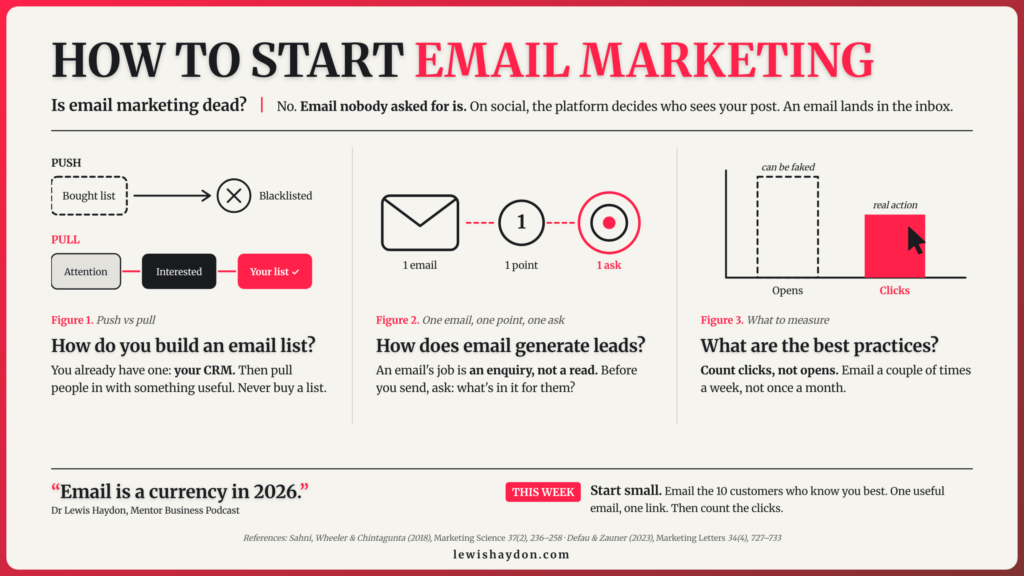
Once you’ve got that list, the next question is how you speak to all of them without spending your whole week on it. That’s email marketing, and it’s the next episode in this series.
I go deeper on sales, marketing and building a business that pays you in my shows on MentorBusiness.com. Sign up or log in at mentorbusiness.com.
Reference: Reinartz, W., Krafft, M., & Hoyer, W. D. (2004). The customer relationship management process: Its measurement and impact on performance. Journal of Marketing Research, 41(3), 293–305.
Listen or watch on your favorite platforms
Listen to the full episode: What Is a CRM? How to Build One for Your Small Business — Mentor Business Podcast, Episode 125



A system that remembers every customer and lead, what you last said, and when to get back in touch. Not to start. A spreadsheet with a next action date works until you need automation. In my experience, it's rarely the software. It's whether the team uses it and owns the result. No. Build your own list of warm leads with a lead magnet and nurture them.FAQs
What is a CRM in simple terms?
Do I need CRM software?
Why do businesses fail with a CRM?
Should I buy a list of leads?