Whether you’ve never sent a marketing email, or you’ve been sending a newsletter nobody clicks, this is how to start email marketing properly. Most owners I work with get stuck on three beliefs: email is dead, you need a big list first, and emailing often annoys people. In email marketing for small business, all three cost you sales from people who already know you.
Is email marketing dead?
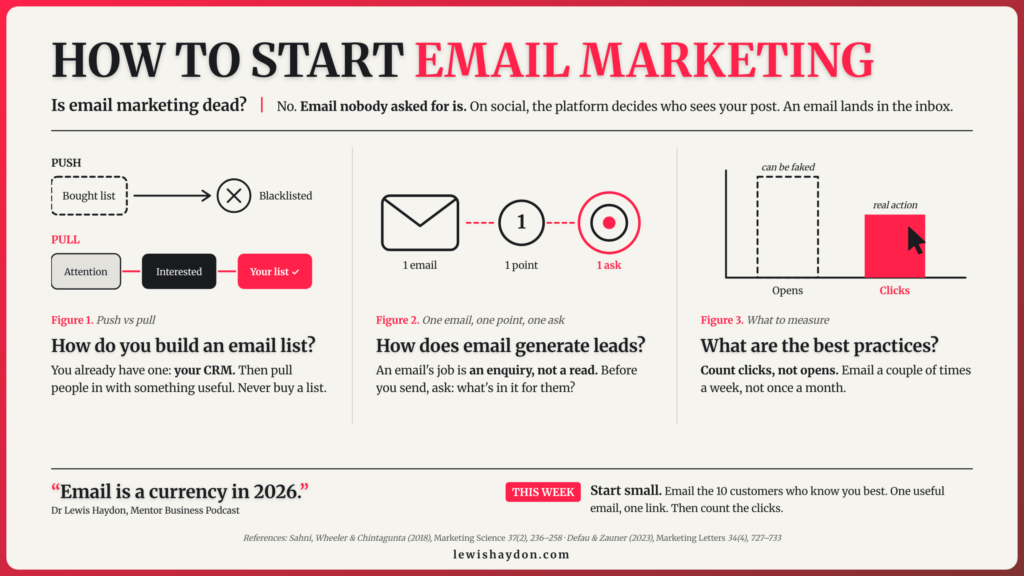
No. What’s dead is email nobody asked for. Large companies employ whole teams to do email marketing, and a small business can do it for a few dollars a month with the right CRM. On social media, the platform decides who sees your post. An email goes straight into their inbox.
You checked your inbox today and saw spam. Fair enough. But which emails do you actually unsubscribe from? Usually the ones you never signed up for. If there’s something in it for you, you stay. There’s a big difference between someone messaging you on LinkedIn fifteen times and an email you asked for when you showed interest in a product.
As an owner, and from coaching a lot of businesses, I see the same pattern. The people who say email marketing doesn’t work are doing it wrong. When we put the right email process in, the next coaching call starts with: “Lewis, I’ve had some leads come through.” Where from? People who were already on their CRM. They just weren’t talking to them enough. That’s one of the most common email marketing mistakes: being inconsistent, or sending one newsletter a month and hoping.
People don’t remember one email. They remember something that interests them showing up again and again. I picture it as a planet with satellites orbiting it. When someone joins your world, they orbit you for a while, and if you go quiet, someone else’s gravity pulls them away. Email keeps them in your orbit until they’re ready to buy.
And you can’t know when that will be. You might not need a vet today. But when your dog is sick, who do you go to: a Google search, or the vet whose emails, reviews and stories you’ve been reading for months? If you own a dog, why would you unsubscribe from emails that look after your dog?
How do you build an email list?
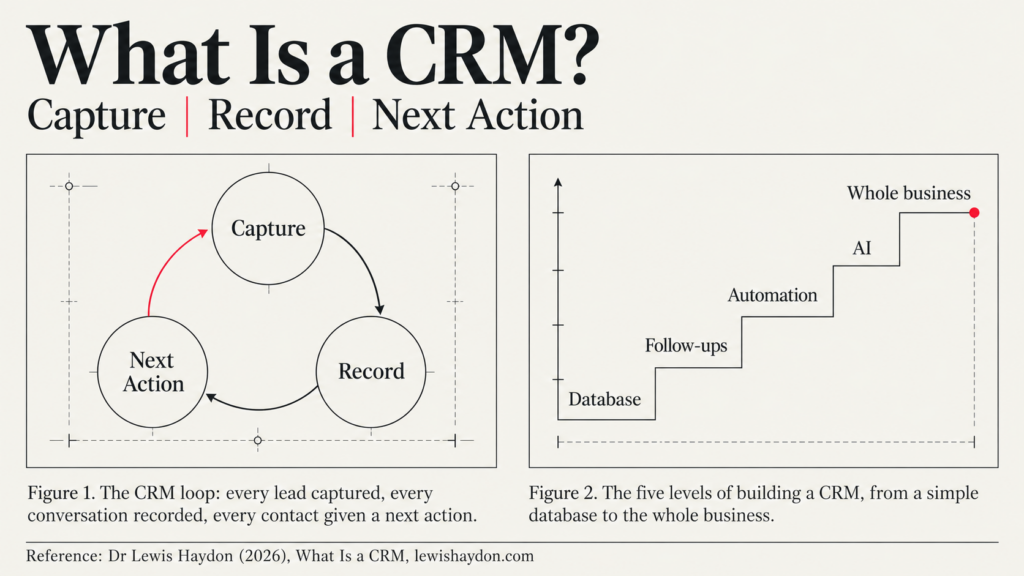
You already have one: it’s your CRM. You don’t need thousands of people before you start emailing. Never buy a list. A bought list is full of unqualified people, it’s the lazy way to build a database, and in many countries emailing people who didn’t agree to it breaks the rules and gets you blacklisted.
If you haven’t sorted your CRM yet, start with the previous episode on CRMs. Then build the list the right way, which is pull, not push. Push is the bought list of “business owners in the USA” that lands in someone’s inbox uninvited. Pull is people who are genuinely interested.
Here’s how I do it. My TikTok is approaching 60,000 followers, and the content is built to go wide. Most of those people don’t own a business, so I filter down: the ones who own one, then the ones who want to grow it. To them I offer something useful for free. The only thing it costs them is their email. Email is a currency in 2026.
That’s the method for any small business: get attention on your channels, filter it down to the people who are interested, and give them a reason to swap their email for something useful. Touch them in more than one place, on Instagram, LinkedIn, WhatsApp and email, because if you lose them, somebody else’s marketing will grab them. It works through paid ads, SEO, YouTube, picking up the phone, even flyers. Whatever the route, you need a call to action that captures an email. Think of it as a bucket with no holes in it, filling with people who will buy, can buy, or have shown an interest.
How does email marketing generate leads?
An email’s job is an enquiry, not a read. A newsletter tells people your news; a good email asks them to act. Give every email one point and one ask: reply, book a call, click through, or come to an event. Always ask what’s in it for them, and send the click to a page built for that one action.
If someone in your team spends a day a week on emails, those emails need to pay, because you’re paying for that day. Before anything goes out, ask WIIFM: what’s in it for me? Why should I open this? Why should I click? And when I click, where do I land?
The belief that stops this is “a newsletter keeps us front of mind”. It builds a bit of awareness, and a weekly one beats a monthly one. But it ends without an ask, so it rarely produces a lead. What works better is an email aimed at a pain your customer actually has.
To find those pains, listen to your salespeople. What objections are they hearing? What gets customers excited? If you record your sales calls and run them through AI, that tells your marketing exactly what to write about. You know your customers better than someone writing emails at a desk all week.
Then don’t send people back to the top of the funnel. They’ve already given you their email, so the next email should take them one step further: a meeting, an event, a decision.
And drop the tricks. A 2018 field experiment across millions of emails found that putting the reader’s name in the subject line lifted results. When researchers re-tested it in 2023, the first-name trick no longer worked. Tricks wear off. Relevance doesn’t. So does timing: “insure your pet now, before it gets sick” lands because it arrives when it matters.
What are the email marketing best practices?
Measure the right thing. Most owners judge email on open rate, but opens don’t tell you whether it’s working; clicks and sales do. Email often enough to be remembered, a couple of times a week rather than a monthly newsletter, and earn that right by making every email useful.
Marketers love open rates. The real question is how many sales came from the email, and answering it needs a CRM that tracks more than sends. A good one shows who clicked, and when they converted, all the way back to the moment they first found you on Google or downloaded something from social media.
“Emailing often annoys people” only holds when the email isn’t welcome. At MentorBusiness.com we see very few unsubscribes, because members joined for the platform and every email gives them something: new content, new features, tools, offers and discount codes. If they unsubscribe, they lose it.
So here’s how to improve email marketing in your own business. Imagine I challenged you to send one email a day for a month. What would you send? How would you keep their interest? Are you telling people how great you are, or how great you’ll make them?
Where to start this week
Take the list from your CRM, pick the ten customers who know you best, and send them one useful email. Write it like a message to one person, with one link at the end. Then count the clicks, not the opens.
Once you’re sending regularly, the next question is which version works better: a different subject line, a different header, a different layout. That’s split testing, and it’s the next episode.
Anyway, I’ve said enough. If you want to talk this through for your business, book in a virtual coffee at lewishaydon.com.
References:
Sahni, N. S., Wheeler, S. C., & Chintagunta, P. (2018). Personalization in email marketing: The role of noninformative advertising content. Marketing Science, 37(2), 236–258. https://doi.org/10.1287/mksc.2017.1066
Defau, L., & Zauner, A. (2023). Personalized subject lines in email marketing. Marketing Letters, 34(4), 727–733. https://doi.org/10.1007/s11002-023-09701-7
Listen or watch on your favorite platforms
Listen to the full episode: How to Start Email Marketing (Stop Sending Newsletters) — Mentor Business Podcast, Episode 126



Yes, when the people on your list asked to be there and each email gives them something. Your email goes straight to their inbox, unlike a social post, which the platform decides whether to show. No. A bought list is unqualified people who never asked to hear from you. In many countries it breaks the rules, and it can get you blacklisted. Often enough to be remembered: a couple of times a week beats a monthly newsletter, as long as every email is useful and has one clear ask.FAQs
Is email marketing still worth it for a small business?
Should I buy an email list?
How often should I send marketing emails?