The latest and most exciting technological breakthrough is undoubtedly Artificial Intelligence. The AI industry emerged as a concept a long time ago, but only a few years back, we saw a significant improvement in the field. Today, it is everywhere.
Businesses that are not using AI are destined to fail. Whether we like it or not, AI technology are running everything around us, and if we don’t adapt, we will surely lose the race with it. Growing your business using AI tools is not optional anymore, but mandatory.
What are AI Models for Business?
Nearly every industry today has a set of AI tools ready to help streamline operations and complex tasks at any given time. Instead of paying enormous amounts to employees for working overtime, these tools are here to get the job done fast and simple.
When we mention AI tools, we actually mean specialized software based on AI and programs, built to learn and provide services at the same time. For example, there are multiple AI tools for writing, programming, finances, graphic design, but also powerful AI bots ready to do nearly anything you need in seconds and help with every question.
The Best AI Tools by Category for Growing Your Business
Not every business needs the same tools. Different industries have needs that are not the same, which is why they’ll look for a specialised set of AI tools made specifically for their needs. Marketing companies will not use the same AI software as sales companies will. Here’s a list of industries and their commonly used AI programs.
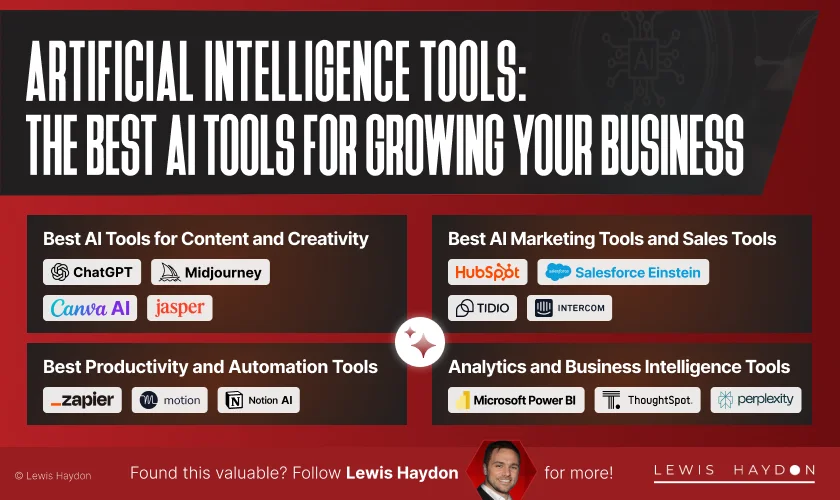
1. Best AI Tools for Content and Creativity
Creative AI apps make it easy to generate high-quality visuals, videos, and text. These tools help marketing teams create engaging campaigns quickly and at scale.
- ChatGPT: A writing assistant that uses natural language to generate text, summarise documents, and support research tasks. With its API and prompt flexibility, ChatGPT is one of the best AI writing tools in 2025.
- Canva AI: A design tool that combines photo editing with AI image generation, making it simple to create content effortlessly for social media marketing and websites.
- Midjourney: A generative AI tool that transforms prompts into realistic AI images, ideal for creative agencies and design studios.
- Jasper.ai: A content creation platform that helps marketing agencies generate high-quality blog posts, product descriptions, and website content using machine learning.
2. Best Productivity and Automation Tools
AI automation makes it easier to streamline tasks across different platforms.
- Zapier: An AI-powered automation app that connects workflows between web pages, email, and productivity apps like Google Docs or Google Ads.
- Motion: A productivity app that uses AI to optimise schedules and manage workspaces, acting as a personal ai assistant.
- Notion AI: A flexible workspace that leverages AI tools to summarise notes, create content, and assist with research tasks.
3. Best AI Marketing Tools and Sales Tools
AI marketing tools are transforming how campaigns are managed and optimised.
- HubSpot: A leading AI-powered marketing platform that helps teams optimise campaigns, track leads, and create engaging marketing content.
- Salesforce Einstein: A powerful AI product integrated into Salesforce that supports sales teams by predicting customer needs.
- Intercom & Tidio: AI chat apps designed to enhance customer support with automated, natural language responses that create realistic interactions.
4. Analytics and Business Intelligence Tools
Business intelligence tools provide leaders with valuable insights through AI-generated reports.
- Microsoft Power BI: An AI app that turns raw data into interactive dashboards, helping businesses make smarter decisions.
- ThoughtSpot: A search engine–style tool that allows teams to explore data intuitively using language model queries.
- Perplexity AI: A modern AI search engine that combines research tasks and summarisation, making it a useful AI tool for analysing market trends.

Benefits of Using AI Software for Business
Everyone says that AI tools are running today’s industry, but what are they actually doing? They are doing different tasks across different fields, but what actually are these tasks, and how do they contribute to particular companies? Here’s a quick list of your benefits when you start using AI tools.
Increased Efficiency
AI-powered software helps companies automate repetitive tasks, saving time and reducing manual errors. From handling email responses to generating high-quality product descriptions, AI tools act as a reliable assistant that improves daily productivity. With free trials and free tiers available, businesses can explore the best AI tools before committing to a plan.
Enhanced Customer Experience
Generative AI allows companies to create realistic AI conversations that improve customer service. AI generated apps like chatbots can respond instantly, making use case and customer support more responsive and personalised. By using natural style language capabilities, AI tools like ChatGPT or Intercom can deliver a smooth experience that builds trust and loyalty.
Better Decision-Making
Back in the day, business owners and CEOs used to make decisions based on their experience and available information. Today, AI makes extremely precise predictions about market changes, industry growth, and many other things. Artificial Intelligence has all the required data to analyse and summarise before reaching a final decision for you.
Cost Savings
The use of AI to automate tasks reduces the need for large teams handling manual processes. AI apps can handle scheduling, marketing campaigns, or even SEO and content marketing, cutting operational costs. Free AI tools and free plans also make advanced technology accessible to small businesses.
Enhanced Risk Management
AI detectors and intelligence tools are designed to spot risks before they escalate. From fraud detection to identifying weaknesses in a workflow, AI provides advanced solutions for maintaining business security. Tools like AI content detectors also help companies ensure authenticity in marketing content.
How to Choose the Right AI App?
It all depends on the industry, type of business, and the severity of the problem you’re focusing on. Marketing agencies will need tools that are effective in developing social media plans, but banks need AI to calculate the most complex mathematical problems.
Also, smaller businesses might not be capable of spending a lot of money on expensive AI products. They will need free versions that will only help their employees with complex tasks. When making a choice, it’s essential to mind scalability, security, and seamless integration with your existing systems.
FAQs
Are there risks associated with using AI tools?
Yes. Risks include reliance on inaccurate AI-generated content, privacy issues, and potential misuse of data. Businesses should combine AI help with human oversight and use trusted providers.
What is the future of AI and the trends in AI for business?
The future of AI points to more advanced llms, realistic ai agents, and seamless integration into workspaces. Tools by category will expand, with AI meeting assistants, video generation apps, and notebooklm shaping new tools in 2025.
Are free AI tools secure for business use?
Some free AI tools are secure, especially those offered by established providers like Google AI or Google AI Studio. However, businesses should review terms of use and avoid relying on free to use platforms for sensitive data.
Can small businesses afford AI-powered tools?
Yes. Many AI products offer free plans or free tiers, giving small businesses the chance to leverage AI tools without a large budget. Even paid versions often come with affordable subscriptions designed to support growth.