Every business throughout its growth faces multiple challenges within and outside the organisation. Both matter equally. Outside factors determine how well the business will expand into the market, and the inside situation determines the quality of the work.
The SWOT analysis covers both. It is the perfect strategy for companies that are trying to set the right path and follow it. With it, companies find out about the internal strengths and issues, while at the same time addressing the outside problems and the chance for growth.
What is and Why is SWOT Analysis Important?
We already touched base with the previous section when we roughly explained what such an analysis can do to a business, but let’s dive into the matter more deeply. A SWOT analysis is the perfect way to assess the strengths and weaknesses of the organisation. These are the first two letters of the acronym SWOT, where the last two stand for Opportunities and Threats.
In short, a SWOT Analysis determines the strengths and weaknesses the business owns and the opportunities and threats that come to it from the outside. A mix of all these things shows how well an organisation performs and how well it can expand. A SWOT analysis is the perfect way for companies to develop a strategy for the future and create a business plan that will fit their needs and goals.
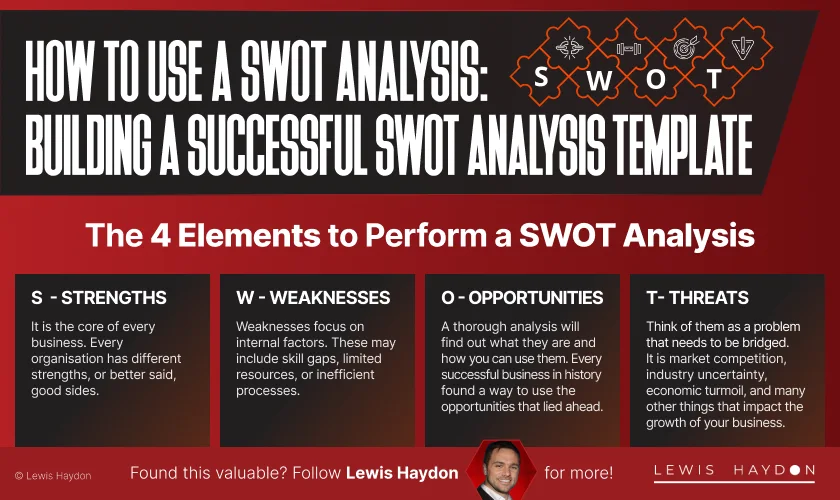
The 4 Elements To Perform a SWOT Analysis
The power of the SWOT analysis lies in every segment of it, but what do all of these things mean? What does it mean when we say Strength? How do we determine the strengths of the company? Why does this matter so much? Let’s look at every segment individually. Let’s see what SWOT stands for?
1. S – Strengths
S stands for Strengths – it is the core of every business. Every organisation has different strengths, or better said, good sides. It may be the power of the employees who are skilled and experienced, a creative and fearless CEO, an excellent structure, or an innovative vision. Whatever that strength is, the company must be aware of it, nurture it, and build the entire business around it.
2. W – Weaknesses
Weaknesses and threats are part of the SWOT framework, but weaknesses focus on internal factors. These may include skill gaps, limited resources, or inefficient processes. A comprehensive SWOT helps team members see areas where the business needs improvement, allowing strategies to overcome these challenges.
3. O – Opportunities
There are always opportunities out there, but you might not be aware of them. A thorough analysis will find out what they are and how you can use them. Every successful business in history found a way to use the opportunities that lied ahead. You might be the best there is, but if there’s no one to show it, it’s useless. Finding the right opportunity for growth is crucial.
4. T – Threats
Finally, threats. Think of them as a problem that needs to be bridged. It is market competition, industry uncertainty, economic turmoil, and many other things that impact the growth of your business. To be sure that these won’t harm you, you must first recognise them. Once you do this, you’re ready to look for solutions.

Benefits of SWOT Analysis in Your Business
Without a professional SWOT analysis, companies are practically stabbing in the dark. It takes a thorough analysis to get a comprehensive view of the business, the market, and the industry in general. Based on it, companies can make informed decisions and trace the path toward success.
Supports Strategic Planning
Analysis allows businesses to create actionable strategies. Using a SWOT matrix clarifies internal versus external factors, guiding management to prioritise objectives. SWOT analysis helps ensure that the overall business plan is realistic, focused, and aligned with long-term goals.
Improves Team Collaboration
SWOT analysis involves team members across departments. By pairing your SWOT with collaborative discussions, the process uncovers diverse insights. Team members contribute knowledge of internal strengths, weaknesses, and external factors that impact the business. This shared understanding enhances business operations.
Enhanced Decision Making
A comprehensive SWOT analysis provides clear business insights. Evaluation of internal strengths and the external environment supports informed decisions. SWOT analysis can help leaders weigh options and take actions that reduce risk and maximise potential outcomes.
Resource Allocation
SWOT analysis helps identify priorities. Companies can allocate resources to areas with the highest impact. Internal strengths are supported, weaknesses addressed, and opportunities pursued efficiently. This ensures business strategies are realistic and actionable.
Identify Strengths and Weaknesses
Analysis helps identify what a business does well and areas needing improvement. Internal factors, such as personnel skills or operational efficiency, are assessed. A personal SWOT analysis may also be used by team members to align individual growth with business needs.
Overcome Organization’s Threats
SWOT analysis to identify threats allows businesses to act proactively. By understanding external factors that could affect your business, strategies can be implemented to reduce risks. Threats may include competitors, market changes, or regulatory challenges, all of which can impact business operations.
6 Ways for Building a Successful SWOT Analysis
Some business owners think that they can conduct an individual analysis that will show them the same things as the pros would. They think they can use swot analyses to find the solutions on their own, but it’s always best if you let professionals do it.
You can always use a free SWOT analysis template that you’ll find online, but the best solution is hiring a professional agency that will do it for you. They will give you the competitive advantage you’re looking for and ensure you head in the right direction.
1. Set a Clear Objective
The objective of a SWOT analysis should be defined before starting. Clear goals guide the evaluation of internal versus external factors and keep the analysis focused. This ensures that the SWOT analysis is a powerful tool for business planning.
2. Brainstorm Internal and External Factors
Team members identify internal factors such as strengths and weaknesses, as well as external opportunities and threats. Brainstorming allows comprehensive SWOT coverage and ensures all relevant factors affecting your business are captured.
3. Prioritize Key Factors
Analysis is more effective when priorities are clear. Key factors that impact your business are highlighted. Prioritising allows leaders to focus on areas with the highest potential for growth or risk mitigation.
4. Develop Strategic Actions
A SWOT template is used to pair internal strengths with external opportunities. Analysis also considers weaknesses and threats. Developing actions based on this evaluation turns insights into business strategies that can grow your business.
5. Implement and Monitor Changes
A good SWOT analysis doesn’t end on paper. Strategies should be implemented and progress monitored. Analysis allows adjustments, ensuring that business strategies remain aligned with changing internal and external factors.
6. Turn Analysis into Actionable Strategies
SWOT analysis helps transform evaluation into results. By turning insights into actionable strategies, businesses can capitalise on opportunities and mitigate threats. A comprehensive SWOT ensures that business decisions are practical and informed.
What Tools Can Help When You Use a SWOT Analysis?
Various tools support a SWOT analysis. Data analysis tools, strategic planning platforms, and visualisation software all make it easier to evaluate internal versus external factors. Using these tools streamlines the process and improves accuracy.
The human resources team uses various tools and strategies to make the best of the team, but when you’re using the SWOT strategy, your company does well in all segments, not just internally. Here are a few tools that help in this process.
Data Analysis and Research Tools
Research and data analysis tools allow businesses to assess external factors that impact their business. SWOT analysis helps identify trends, market conditions, and competitor behaviour, providing valuable business insights for strategic planning.
Strategic Planning Tool
Strategic planning tools help turn analysis into action. A SWOT analysis template can be integrated with planning software, allowing companies to link insights directly to business strategies and track progress.
Visualization and Design Tools
Visualisation tools help create a clear SWOT matrix. Charts, diagrams, and editable SWOT analysis templates make findings easier to understand, share, and use in strategic decision-making.
SWOT Analysis Example vs PEST Analysis
Many businesses focus only on the external factors. They are mainly using the PEST analysis, but the SWOT option is better because it also looks at the internal factors. These are equally important for the growth of the company. So many businesses failed because they were only focused on their clients and market opportunities. They forgot to take care of their own people and resources and eventually imploded.
FAQs
Who should be involved in a SWOT analysis?
It is best if everyone is involved. The optimal solution when conducting a SWOT analysis is to have at least one member per department. You need people that have diverse expertise and will provide the full picture of the company.
Is SWOT analysis only for businesses?
Although businesses mainly use it, it is useful for individuals, too. With it, you can work on personal growth and achieve personal success. It is also excellent for various projects and non-profit organisations because the analysis highlights all strengths and weaknesses that might derive from the main objective.
How long does it take to complete a SWOT analysis?
The time varies depending on the scope. A basic SWOT analysis may take a few hours, while a comprehensive SWOT could take several days of research, brainstorming, and review.
How often should I update my SWOT analysis template?
It should be updated whenever significant internal or external changes occur. Regular reviews ensure the SWOT analysis remains relevant and continues to provide valuable insights for business decisions.