Closing is the final step in the sales process. It determines if all the effort you’ve put in so far leads to success. This step is critical, so it requires careful attention.
Closing a deal can feel stressful for sales reps. To help, we’ve compiled 15 effective sales closing techniques to increase success rates. These techniques are designed to help reps close deals with confidence and efficiency.
Mastering the Art of Closing Sales
Study your prospects and adjust your approach to meet their needs and expectations. Much like chess, your first moves influence the outcome. When the entire sales process is intentional and focused, closing the deal becomes a collaborative effort with the buyer rather than a challenge. Regular practice and training can help you improve sales skills, ensuring each interaction is strategic and effective.
Why Are Strong Sales Processes Important
To close more deals, focus on more than just the final pitch. Every step of your sales process matters, from qualifying leads to managing stakeholders and aligning with other departments. Improving these steps can significantly increase your success rate.
Why Closing Techniques Are Vital for Sales Success
The right sales closing technique depends on the sales deal, the customer, their objections, and goals. Picking the right approach helps sellers in key ways:
Faster sales cycles
Closing a deal doesn’t always mean it’s a done deal. Deals can stall in the final stage for weeks or months. Using effective closing tactics helps salespeople move deals forward confidently without coming off as pushy.
Stronger customer relationships
Customers don’t want to deal with pushy or overly assertive reps. At the same time, sellers who appear unsure or unprepared don’t build trust. The right closing technique allows sellers to tailor their approach to each prospect, strengthening trust. Trusted brands are more likely to win over customers, increasing the chances of closing deals.
Less wasted time
Chasing uninterested prospects wastes valuable time. Sellers who master effective closing strategies can better gauge if a deal is worth pursuing. They’ll know when to move on and focus on more promising opportunities.
Improved ideal customer profile (ICP)
Refining your ICP involves studying what works. Analyzing the results of specific closing techniques can reveal patterns and help you target new markets. Tracking which methods drive success allows you to define and expand your ICP for better results.

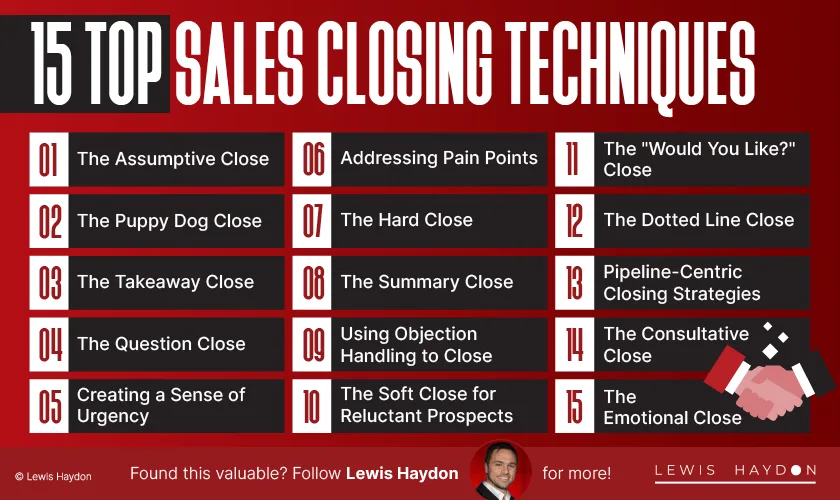
Top 15 Best Sales Closing Techniques to Seal the Deal
We’ll show you how to close the sale effectively. Learn 15 proven techniques to improve your success as a sales professional.
1. The Assumptive Close
This sales technique is based on the power of positive thinking. Sales reps approach the deal with confidence, believing it will close successfully. According to Forbes, optimistic sales reps outperform pessimistic ones by 57%.
The assumptive close works when sales reps treat the deal as confirmed once the prospect meets most of the criteria during the sales process. This approach limits the time prospects have to overthink, reducing the chances of objections and complications.
To apply this, reps should ask questions that imply the deal is already done. For example:
“Great, let’s process your order and schedule your delivery for next week. Do you prefer morning or afternoon?”
2. The Puppy Dog Close
The idea is simple: if a prospect sees the value in a product, they are unlikely to walk away. Think about someone visiting a pet store. If they get to play with a puppy, chances are, they’ll buy it. The same concept applies here—let the prospect try the product. If they see its worth, they’ll likely make a purchase.
This approach works because you’re not pressuring anyone to buy. Instead, you’re giving them the chance to decide for themselves. For example: “Take the product home for a trial period with no obligation. If you’re not satisfied, you can return it for a full refund.” Simple, effective, and persuasive.
3. The Takeaway Close
What happens when you take a toy or candy from a child? The child cries or shouts because they suddenly want it more. This same principle applies to a sales closing technique used with prospects.
If a prospect resists your offer due to price, offer a discount but remove some features. They will often focus more on the features being taken away than the discount itself.
Another tactic is walking away from the deal when the prospect isn’t showing real progress. Stepping back shows confidence in your product and can push them to reconsider its value.
For example:
Based on what we’ve discussed, our product seems like a great fit for your needs. Are you ready to move forward with your order?
4. The Question Close
The Question Close technique helps sales reps address objections and offer solutions by asking specific questions.
Examples:
- Do you think our product solves the problem you’re facing?
- Is there any reason not to proceed with the shipment?
These questions encourage prospects to share concerns that might otherwise stay hidden.
5. Creating a Sense of Urgency
To keep your deals moving, it’s important to create a sense of urgency. This encourages prospects to take action and move forward. You can do this with time-limited discounts, free onboarding, or offers that provide immediate value.
Make sure your offer matches what the prospect truly needs. Avoid making them feel pressured, as this could jeopardize the deal.
6. Addressing Pain Points
Addressing pain points is a powerful sales closing strategy that focuses on understanding and resolving the challenges and concerns of potential customers. By empathetically listening to their needs and pain points, sales professionals can position their product or service as the solution that addresses those specific pain points.
This approach helps build trust and credibility while demonstrating a deep understanding of the customer’s unique situation. By addressing pain points directly, sales reps can highlight how their offering not only meets the customer’s needs but also provides tangible value and relief. This targeted approach fosters a sense of confidence and reassurance in the customer, making them more inclined to move forward with the purchase decision.
7. The Hard Close
To get a hesitant customer to make a decision, you can try the hard close. This approach takes confidence and should only be used as a last resort. It involves directly asking someone to buy, which can be challenging, especially for beginners, but boldness often leads to success.
Example: “Could you please sign the agreement?”
8. The Summary Close
The Summary Close technique works by bringing all the key points together. Sales reps highlight the main features, benefits, and details of the product already discussed. This helps prospects clearly recall what they gain from the deal. It’s especially useful for long discussions.
Example:
“To summarize, we’ve gone over your needs, and our product checks all the boxes. Are you ready to proceed with the purchase?”
9. Using Objection Handling to Close
The objection-closing technique helps when you’re unsure why a prospect is hesitating. They may still have concerns. Once you’re confident they understand your product, ask if anything is holding them back.
Example:
“Bob, is there anything stopping you from signing this deal?”
This lets you address their concerns right away and close the deal faster.
10. The Soft Close for Reluctant Prospects
The soft close allows you to present the benefits of your product and ask a simple question to gauge interest.
For example:
“If I told you I could reduce widget maintenance by 25% and improve widget productivity by 15%, would that fit with your company goals?”
This approach avoids asking for a commitment and gives you space to understand their needs better.
11. The “Would You Like?” Close
The “Would You Like?” close is a highly effective sales closing strategy that aims to prompt a favorable response from the prospect. By presenting the benefits of your product or service and asking a direct question, you create an opportunity for the prospect to express interest and move closer to making a purchasing decision.
For instance, you might inquire, “Would you like to see how our product can streamline your workflow and increase productivity?” This approach allows the prospect to envision the positive impact of your offering and encourages them to take the next step in the sales process.
12. The Dotted Line Close
The Dotted Line Close is a sales closing strategy that aims to secure a commitment from the prospect by explicitly asking for their agreement or decision. This approach involves presenting the benefits of your product or service and then directly asking the prospect to make a purchasing decision. By creating an explicit opportunity for the prospect to express their interest and take the next step, you can encourage them to move closer to making a purchasing decision.
For example, you might ask, “Are you ready to proceed with our product and experience the efficiency it brings to your workflow?” By using the Dotted Line Close, you prompt the prospect to envision the positive impact of your offering and take action, bringing them closer to becoming a customer.
13. Pipeline-Centric Closing Strategies
Pipeline-centric sales closing strategies are essential for driving successful sales outcomes. These strategies focus on effectively managing the sales pipeline and guiding prospects toward a positive purchasing decision. Through pipeline-centric closing strategies, sales teams can enhance their effectiveness and achieve higher conversion rates, driving business growth and customer satisfaction.
14. The Consultative Close
The Consultative Close is a sales method where the salesperson acts more like a consultant than a traditional seller. It focuses on understanding the customer’s needs, offering solutions, and helping them make the best decision. The goal is to build trust by providing personalized advice and recommendations.
For example, a salesperson might say, “Based on your challenges, our premium package seems like the best fit. Should we move forward with setting it up?”
15. The Emotional Close
The Emotional Close is a powerful sales strategy that taps into the customer’s emotions to drive the decision-making process. By understanding the customer’s desires, fears, and aspirations, the salesperson can tailor their approach to create a personal connection and evoke an emotional response.
This approach goes beyond simply presenting facts and features; it aims to touch the customer on a deeper level, resonating with their values and motivations. Through storytelling, empathy, and active listening, the salesperson can build trust and establish a genuine connection with the customer, increasing the likelihood of a successful close.
Overcoming Objections When Closing
A sales objection happens when a lead explains why they won’t buy from you. Common reasons include lack of need, trust, budget, or decision-making ability. While it might feel like rejection, it’s actually a chance to understand your customers better and address their concerns with clear answers.
Common Objections and How to Handle Them
Common objections in sales include lack of need, trust, and budget.
- Lack of need: Explain how your product solves a specific problem they might face.
- Lack of trust: Share testimonials or case studies to build credibility.
- Budget concerns: Highlight the value and potential cost savings your product offers.
Building Trust Through Product or Service Knowledge
Trust is key in sales. You build trust by showing strong knowledge of your product or service. When you understand what you’re offering, prospects feel confident that you can meet their needs. Showing expertise makes you credible and reliable, creating a solid foundation for a successful sales relationship.
Creating Urgency Without Being Pushy
Creating urgency in sales requires careful communication. It’s important to show the value of your product or service without being overly pushy. Understand your prospects’ pain points and explain how your solution solves their problems. Highlight the immediate and long-term benefits while making it clear why acting now matters. Communicate the limited availability of the offer or the risks of waiting too long.
This approach encourages prospects to act while ensuring they feel confident in their decision. The goal is to help them choose what aligns with their needs.
How to Highlight Pain Points Effectively
To highlight pain points effectively, understand your prospects’ challenges and needs. Use clear and concise language that speaks directly to their issues. Explain the risks of ignoring these problems and show how your product or service provides solutions.
Show empathy, offer practical answers, and demonstrate how your solution eases their pain. Position yourself as a trusted advisor by creating a genuine connection and addressing their concerns directly.
Leveraging Time-Sensitive Offers
Time-sensitive offers are a powerful way to close deals and encourage prospects to act quickly. Creating urgency pushes potential customers to make decisions faster. Limited-time promotions, exclusive discounts, or low stock can trigger the fear of missing out (FOMO), prompting immediate action. Clear communication about the offer’s benefits and deadline helps drive conversions. Ensure prospects understand what they gain by acting now.
Sales Team Collaboration for Closing Deals
Sales team collaboration is key to closing deals and growing a business. When team members work together, they can combine their skills and expertise to create a unified strategy. Sharing knowledge and ideas helps the team work smarter and close deals more effectively.
Working together improves communication, coordination, and understanding of customer needs. It allows the team to provide tailored solutions and a better experience for potential clients. Collaboration helps sales teams reach their goals, exceed targets, and achieve success.
Role of Sales Experts in Closing Techniques
Sales experts play a key role in closing deals. They use their knowledge and skills to navigate the final steps of the sales process. With a strong understanding of products and customer needs, they address concerns, handle objections, and guide prospects toward a purchase.
They create urgency, highlight value, and explain product benefits to encourage decisions. Their ability to build trust, connect with prospects, and adapt their approach helps secure deals and increase revenue.
Optimizing Team Sales Strategy for Success
To succeed in sales, teams should focus on clear communication, ongoing training, and data-driven decisions. Open communication within the team helps share insights and improve performance. Regular training ensures sales skills and product knowledge stay sharp in a competitive market. Using data analytics helps teams track trends, adjust strategies, and allocate resources effectively. Prioritizing these steps can improve results, drive growth, and achieve lasting success.
FAQs
How do I know which sales closing technique is best for a specific prospect?
To close a sale effectively, research and analyze your prospect. Focus on their communication style, buying habits, and specific needs. Use this information to tailor your approach, making it easier to engage and persuade them. This increases the likelihood of closing the deal successfully.
What is the role of follow-up after attempting a sales close?
A follow-up sales call should do more than check if the prospect has made a decision. Use it to share helpful information, address any concerns, and show how your solution fits their needs. Itu2019s also a great way to build trust and learn more about their decision-making process.
Are these techniques equally effective for B2B and B2C sales?
Sales closing techniques can work for both B2B and B2C sales, but the approach depends on the audience. B2B sales usually take longer, involve multiple decision-makers, and focus on building relationships. In contrast, B2C sales are faster-paced, requiring shorter messages that highlight the product's value to individual buyers. Adapting your closing strategy to the needs of each audience increases the chances of success.