Leadership comes in all shapes and sizes. Some leaders step back, letting the team run the show, while others stay deeply involved. Pacesetting? It’s a middle ground. It can push teams to excel—but is it always the best fit? Think of it like running a relay. Are you pacing the team or leaving them out of breath?
What is Pacesetting Leadership?
Pacesetting leadership is all about results. Leaders set ambitious goals and expect their teams to follow suit—matching their work ethic, pace, and drive. Sounds effective, right? Well, not always. While it pushes teams to deliver high-quality work quickly, it can also feel overwhelming if used alone. Daniel Goleman, who coined this style, emphasizes the importance of emotional intelligence in leadership. He suggests blending pacesetting leadership with other styles, like coaching leadership, employee motivation strategies, and supportive leadership styles for a more balanced approach.
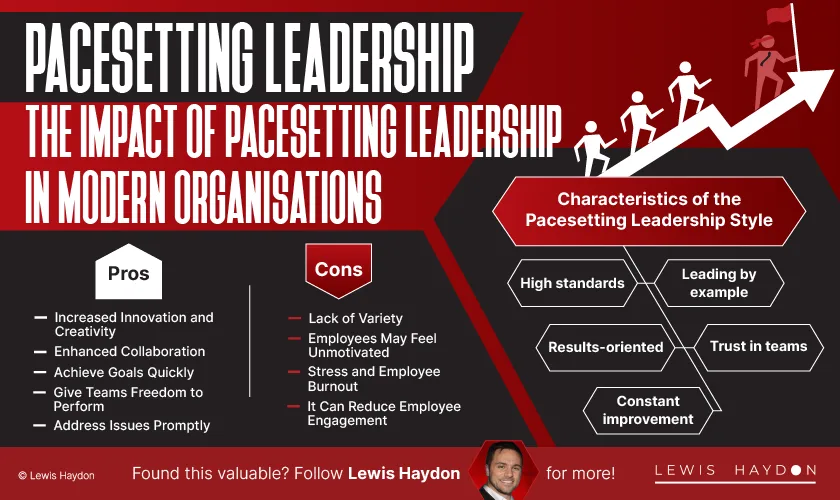
Characteristics of the Pacesetting Leadership Style
Pacesetting leadership is a style of leadership that often comes with a clear goal: to hit ambitious targets. But what defines this approach? Let’s break it down.
- High standards. Ever met someone who always pushes for “just a little more”? That’s a pacesetting leader. They demand top-notch performance—not just from their team but from themselves, too. Excellence and speed? Non-negotiable.
- Leading by example. Imagine a coach running alongside their team during practice, showing exactly how it’s done. That’s the essence here. These leaders don’t just talk the talk; they walk the walk, setting the tone through their own actions.
- Results-oriented. The finish line is always in sight. These leaders are the type to roll up their sleeves and get in the trenches among team members. It’s not about standing back and directing; it’s about delivering results together.
- Trust in teams. They’re not micromanagers. In fact, they often hand over the reins, trusting their team to make decisions and take control. It’s like teaching someone to ride a bike—at some point, you let go and let them pedal.
- Constant improvement. For pacesetting leaders, “good enough” is never good enough. They push for better efficiency, higher quality, and sharper results. Sure, it can feel relentless at times, but isn’t that how progress happens?

Advantages of Pacesetting Leadership
Like any type of leadership, the pacesetting style has its pros and cons. When done right, this type of leadership offers valuable benefits—but how often do we balance ambition with sustainable teamwork?
Increased Innovation and Creativity
Pacesetting leadership pushes teams to go further and faster. It inspires growth, sharpens skills, and drives top-tier performance. Sure, it’s demanding. But isn’t that the point? When leaders set the bar high, people rise to meet it. Momentum builds. Excellence becomes the standard. It’s about setting the rhythm—and watching everyone hit their stride.
Enhanced Collaboration
Pacesetting leadership sparks collaboration by setting ambitious goals that inspire teams to think bigger, push harder, and innovate. It’s about igniting drive—showing what’s possible. The energy is contagious. Can high benchmarks really fuel creativity? Absolutely. Teams rise to the challenge, finding unexpected solutions. This style motivates progress, proving that excellence can be both a goal and a journey.
Achieve Goals Quickly
Pacesetting leadership accelerates success. Short-term goals aren’t just met—they’re surpassed. Teams rally, fueled by ambition and the possibility of achieving time-sensitive objectives. Does the intensity leave room for creativity? It often does, sparking innovation in unexpected ways. Progress feels tangible, immediate. Excellence becomes a shared pursuit. Isn’t that what drives us—the thrill of achieving more, together?
Give Teams Freedom to Perform
Pacesetting leadership thrives on trust. It’s about giving people the freedom to grow. When employees explore without constant oversight, innovation sparks. They try, adapt, and discover their strengths. Confidence isn’t built through hand-holding—it comes from experience, from taking those first unsteady steps. Growth happens in the space you create.
Address Issues Promptly
In a fast-paced, goal-driven approach, leaders focus on strengths but also face flaws head-on. Missed goals? Problems pop up? They quickly pinpoint the why. Solutions aren’t always perfect—or even possible. But, like adjusting a recipe when something’s off, they monitor, adapt, and steer things back on track.
Disadvantages of Pacesetting Leadership
The pacesetting leadership style can backfire if used poorly. Sure, setting the bar high sounds great, but what happens when your team burns out? Let’s break it down into risks and rewards and explain why balance might just be the real secret.
Lack of Variety
Focusing solely on results might seem like the right move, but what’s the cost? Team members may feel stuck—doing the same thing over and over. Sure, results matter, but what happens to creativity? To innovation? If every moment is about outcomes, there’s no room to think beyond the task at hand. Does that really drive success?
Employees May Feel Unmotivated
When the focus is always on hitting targets, motivation can take a nosedive. Imagine running a race that never ends—eventually, anyone would slow down. Constant pressure without acknowledgment or variety wears on people. And when enthusiasm fades, so does performance. Is chasing perfection worth the trade-off if your team feels stuck in an endless loop of expectations?
Stress and Employee Burnout
The pacesetting style of leadership has its flaws. Sure, it pushes for results, but at what cost? Teams can feel overwhelmed, constantly sprinting to meet sky-high expectations. Ever skipped lunch or stayed late just to keep up? That’s the risk here—burnout. And when frustration builds, or self-doubt creeps in, productivity and morale take a hit. Balance matters.
It Can Reduce Employee Engagement
Pacesetting leadership has its flaws. Sure, it drives results, but what happens when the pace feels relentless? Imagine running on a treadmill that only speeds up—eventually, the team’s energy drains. Morale slips. Relationships? Forgotten. Without time to connect or breathe, engagement takes a hit. So, is the constant push forward really worth the cost?
The 4 Essential Elements of Pacesetting Leadership
1. Clearly Communicated Requirements
A pacesetting leader thrives on clarity—clear goals and clear expectations. Without that, quality falters. But here’s the catch: clarity doesn’t mean guidance. Employees are expected to know the “how” without hand-holding. It’s not micromanagement, but is it always fair? Can your team deliver perfectly every time? That’s the challenge.
2. Initiative
Pacesetting leaders often race against the clock, pushing hard to meet ambitious goals. Their urgency drives quick action, but what happens when someone can’t keep up? It’s like a relay race—if one runner slows, the leader might grab the baton and push ahead themselves. There’s little room for delay, but is speed always worth the strain?
3. Trend-Setting
An effective leader who practices this style of leadership leads by doing. They set the pace, expecting others to match their pace. But what happens when someone falls behind? Are they given support or just left behind? It’s like running a race where only a few can keep up. This style inspires some but risks alienating those who need a different approach.
4. Self-Motivation
A pacesetting leader thrives on self-motivation, chasing excellence with relentless drive. But here’s the catch: they often expect the same from everyone else. Can every employee match such intensity? Not always. While high standards inspire, are they sustainable for the team? It’s worth pausing to consider.
The Impact of Pacesetting Leadership in Modern Organisations
Leadership has changed. Remember when bosses simply gave orders, and employees followed? That worked for predictable times. But today? Businesses move fast. Employees expect autonomy. Enter modern pacesetting leadership: it’s not just “lead by example” anymore. Sure, results matter, but so do trust and collaboration. Today’s leaders need empathy and flexibility—like juggling priorities in a busy family. It’s not perfect, but it’s essential for innovation and thriving in a constantly shifting world.
Examples Of Pacesetting Leadership
Pacesetting leaders often push hard to inspire teams. But does it always work? Let’s explore examples that show both sides.
1. Military Leaders
Military leaders often embody pacesetting leadership. They demand excellence, setting ambitious goals, and strict deadlines. Miss the mark? Criticism follows—not just for subordinates but for leaders, too. Yet, there’s no room for external motivation here. Soldiers are driven by purpose, not perks. It’s a leadership style that inspires—but isn’t without its flaws. Can perfection really be sustained?
2. Sales Team Leaders
Sales leaders often lean on pacesetting leadership, pushing teams to hit quotas and drive growth. It sounds ideal, right? But is it sustainable? The high expectations for constant improvement—always beating yesterday’s numbers—can feel relentless. Leaders mirror this, chasing KPIs nonstop. Yet, even the best performers need room to breathe. After all, can anyone sprint forever without slowing down?
3. Sports Team Managers
Coaches often rely on pacesetting leadership, drawing from their own playing days to inspire their teams. They show, not just tell, setting the standard through action. Take Sir Alex Ferguson—his relentless drive shaped Manchester United’s success. But here’s the thing: is it fair to expect players to match that intensity every time? Leadership, after all, isn’t always one-size-fits-all.
4. Headteachers
Headteachers often lean on a pacesetting leadership style, setting clear goals and expecting teachers to meet them. They want teachers to mirror their example—what would they do in the same role? While this high standard assumes intrinsic motivation, it’s not always perfect. After all, can anyone excel without some guidance? Like a coach, support matters too.
FAQs
Who is a famous person with a pacesetting leadership style?
Indra Nooyi, as PepsiCou2019s CEO, exemplified pacesetter leadership by setting bold goals that fueled growth. Jack Welch, leading GE (1981u20132001), took a tougher route. His forced ranking strategy rewarded the top 20 percent but cut the bottom 10 percent.u00a0
When should pacesetting leadership be avoided?
This leadership style sets high standards for everyone, including yourself. Striving for excellence? Great. But what happens when the focus shifts to failures, not wins? That relentless drive can feel less like motivation and more like walking on eggshells.